
When choosing sunglasses, you should look for 100% UV protection. It's not just about a fashion accessory, but about protecting your eyes and the delicate skin around them. Find out why UV protection is so important!
What does UV protection mean?
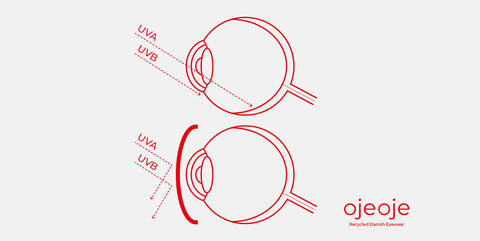
UV protection means that the sunglass lenses filter out the sun's ultraviolet rays, which can harm your eyes and skin. It's an invisible protection within the lens, so it's not the same as dark lenses. UV stands for ultraviolet – a type of electromagnetic radiation from the sun that cannot be seen with the naked eye, but which has a significant impact on your skin and eyes.
Psst… whether you choose sunglasses with prescription or without, all sunglasses from OjeOje are CE-marked, which is your guarantee for 100% UV protection.
Why should you use UV protection?
The sun's UV rays are invisible – but their effect is anything but. Over time, UV radiation can damage the cornea, lens, and retina, increasing the risk of serious eye diseases such as cataracts and macular degeneration. At the same time, the rays can also cause wrinkles and premature aging of the delicate skin around the eyes. Therefore, it is crucial that your sunglasses have 100% UV protection – even on cloudy days, when UV still penetrates.
In short – your sunglasses:
• Protect eyes from harmful UV radiation.
• Reduce eye irritation such as red, watery, or dry eyes.
• Improve vision quality by reducing glare and contrast sensitivity.
• Prevent wrinkles and fine lines around the eyes.
How many different types of UV are there?
There are three types of UV radiation – distinguished by wavelength:
1. UVA (Ultraviolet A): Long-wave radiation (320-400 nm). Accounts for approx. 95% of the UV rays that reach the Earth's surface. They are present all year round, even on cloudy days. They penetrate both clouds and glass and can penetrate deep into the skin and eye tissue. These UV rays cannot be felt, but they are associated with skin aging and eye damage over time.
2. UVB (Ultraviolet B): Medium-wave radiation (280-320 nm). Accounts for 5% of the UV rays that reach the Earth's surface. They are blocked by clouds and glass but penetrate the skin's outer layer, and are the UV rays that make the skin tan, but can also cause sunburn. Can eventually damage the eye's cornea and lens – and in the long run develop skin cancer.
3. UVC (Ultraviolet C): Short-wave radiation (100-280 nm). These rays are the most harmful form of UV, but are fortunately blocked by the Earth's atmosphere and ozone layer, so we are not naturally exposed to them.
Do all sunglasses have UV protection?
No, not all sunglasses have UV protection. Many people think that dark lenses automatically protect against UV rays, but they don't necessarily. It is the UV filter – not the color of the lens – that determines whether your eyes are protected. It should state '100% UV protection' or 'UV400' on the glasses or in the product text.
What does UV400 protection mean?
UV400 means that the sunglass lenses block all UV rays up to 400 nanometers – which covers both UVA and UVB rays, which are the two most harmful forms of ultraviolet light from the sun.
In short:
• UV stands for ultraviolet, invisible rays from the sun, which can harm eyes and skin.
• 400 nanometers (nm) is the limit of the invisible UV spectrum.
• When your glasses have UV400 protection, it means they filter 99-100% of all harmful UV radiation – including the invisible.
Psst… Always buy sunglasses from reliable brands or opticians, where UV protection is documented – like at OjeOje, where all sunglasses have full UV400 protection.
Do dark lenses always have UV protection?
No, glasses with dark lenses are not automatically UV-protective – and that's an important point to know! Dark lenses can actually be worse than no glasses at all – because your pupils dilate in the dark, thereby letting in more harmful UV radiation.
So remember! Always choose glasses with 'UV400' or '100% UV protection' marking.
How dark should your sunglasses be?
Sunglass lenses come in different degrees of darkness, divided into categories 0-4. The category is very important for both comfort and safety in the sun, and indicates how much light the lens lets through:
Category 0 (almost transparent): The lens is completely clear or very lightly tinted. Typically used for safety glasses that protect against wind, dust, or dirt – but not against the sun.
Category 1 (lightly tinted): Slight tint in the lens, which slightly dampens the light. Suitable for cloudy days where you don't need full sun protection.
Category 2 (medium tinted): A moderately dark lens, ideal for mild or changing sun. Useful for slightly bright sun, while driving, or where light and shade alternate – e.g., in urban environments or forests.
Category 3 (regular sunglasses): The most common category. High sun protection for sunny summer days – both at home and abroad. Good for beach trips, hiking, and everyday use.
Category 4 (extremely dark lenses): Blocks almost all light. Used only in extreme light conditions, such as mountaineering, glaciers, or snow areas with high reflection. Not suitable for driving, as it dampens too much light.
So remember: Category only indicates darkness – not UV protection. Regardless of category, your sunglasses should always have a UV400 filter, so your eyes are properly protected.
When should you use sunglasses with UV protection?
You should use sunglasses with UV protection every time your eyes are exposed to daylight – and not just when the sun is shining brightly. UV radiation penetrates clouds and is strongly reflected from water, snow, and light surfaces. Pay attention to when you should use sunglasses:
• On sunny days. Direct sunlight emits large amounts of UV radiation, which can harm both your eyes and the skin around them.
• On cloudy days. Up to 80% of UV rays penetrate clouds, so your eyes are still exposed even when the sun is not visible.
• By water, sand, and snow. These surfaces reflect UV rays and amplify their effect – increasing the risk of eye damage.
• When driving. UV rays penetrate car windows, and prolonged exposure can lead to both glare and damage to the eye's lens and retina.
• At high altitudes UV radiation increases with altitude – approx. 10% for every 1000 meters you ascend. Glasses with strong UV protection are therefore extra important in mountainous areas.
Psst… if you use reading glasses daily, we highly recommend investing in a pair of sunglasses with prescription. Then you can read a book or check your phone in the sun – without having to switch between glasses or being exposed to harmful UV rays!
So remember: Always use sunglasses with 100% UV400 protection – to protect your eyes from invisible and harmful rays. Your eyes see every ray of sunshine – so take care of them every day, all year round.
Frequently asked questions about UV protection
Is UV light bad for the eyes?
Yes. Prolonged exposure to UV radiation can damage the cornea, lens, and retina, and increase the risk of eye diseases such as cataracts and macular degeneration. At the same time, UV light can accelerate skin aging around the eyes. Therefore, daily protection is important – all year round.
What does 100% UV protection mean?
It means that the sunglass lenses filter out all harmful UV rays from the sun. UV protection is an invisible feature in the lens and has nothing to do with the darkness of the lens.
What is the difference between UVA, UVB, and UVC?
UVA accounts for the majority of UV radiation we are exposed to and can cause aging and eye damage over time. UVB can cause sunburn and corneal damage. UVC is the most harmful type, but is fortunately blocked by the atmosphere.
How high UV protection should sunglasses have?
Sunglasses should always have UV400 protection or be marked with "100% UV protection". This is the highest standard and ensures that both UVA and UVB rays are effectively filtered – regardless of whether the lens is light or dark.
When should I use sunglasses with UV protection?
Every time your eyes are exposed to daylight – even on cloudy days. UV rays penetrate clouds and are reflected from water, snow, and light surfaces, and the UV level also increases at high altitudes.