


It can be confusing at first glance to understand the numbers and abbreviations on your eyeglass prescription. Read on to find out what the result of your eye test means, so you're well-equipped when ordering new glasses.
What should an eyeglass prescription contain?
An eyeglass prescription (also called a spectacle prescription) is your guide to getting the right glasses or contact lenses that precisely fit your vision needs. But what exactly should be on an eyeglass prescription for it to be valid and usable at all opticians? To avoid misunderstandings and ensure your glasses are manufactured correctly, it is important that all essential information is included. Here are the 6 most important points that your eyeglass prescription should contain, so you know what glasses to look for when buying new ones.
Find out what an eyeglass prescription should contain:
1. Personal information:
• Your name and date of birth (to ensure the prescription is personal).
2. Strength information (for each eye):
• Sphere (sph): Indicates the strength to correct nearsightedness (-) or farsightedness (+).
• Cylinder (cyl): Shows the correction for astigmatism.
• Axis (axis): Indicates the direction of the cylinder (0-180 degrees).
3. Addition (add):
• Extra strength for the reading area (used for bifocal or progressive lenses).
4. Pupillary distance (PD):
• Measured in mm and indicates the distance between your pupils – and can be divided per eye (e.g., 31.5 mm) or combined (e.g., 63 mm).
5. Prism (if necessary):
• Shows any need to correct strabismus or double vision.
• Direction: Up, down, in, or out.
6. Other information:
• Visual acuity: Measurement of visual sharpness (e.g., 6/6 for normal vision).
• Prescription date – should not be older than 1-2 years.
• Optician's name and stamp.
Psst… if you are in doubt about whether your eyeglass prescription is correct, you can always ask your optician or ophthalmologist.
What do the different terms mean?
Below, we guide you through the different terms so you can easily understand your eyeglass prescription:
• Sph: Shows your basic spectacle strength, either for nearsightedness (-) or farsightedness (+).
• Cyl: Indicates the strength to correct astigmatism.
• Axis: Shows the direction of the astigmatism on a scale from 0° to 180°.
• Add: Extra strength for reading glasses or multifocal lenses, typically used for age-related farsightedness.
• Visual acuity: A measure of your visual sharpness, i.e., how clearly and distinctly you can see.
• Bin: Shows how your eyes work together.
• PD: The distance between your pupils measured in millimeters.
What does sph mean?
The sphere (sph) indicates the basic strength your glasses need to correct either nearsightedness (myopia) or farsightedness (hyperopia). How do you read the number? If there is a minus (-) in front of the number, it means you are nearsighted and need help to see at a distance. If there is a plus (+), it means you are farsighted and need help to see up close. For example, if it says sph -2.00, it means you are nearsighted with a strength of -2.00 diopters (the unit of measurement for lens strength).
What does cyl mean?
Cylinder (cyl) indicates the degree of astigmatism, which is an irregular shape of the eye's cornea or lens. This irregularity causes light rays to refract incorrectly, resulting in blurred or distorted vision. How do you read the number? Like with sph, the cylinder strength can be both positive (+) or negative (-). The higher the number, the greater the astigmatism. For example, if it says cyl -0.50, it means you have astigmatism with a strength of -0.50 diopters.
What does axis mean?
The axis indicates the angle (in degrees) of the astigmatism. It will always be between 0° and 180° and determines how the cylinder should be placed in the lens to correct your vision correctly. How do you read the number? The axis is always given as a number without a plus or minus. If it says Axis 90, it means the cylinder should be aligned along 90 degrees.
What does add mean?
Add (addition) on an eyeglass prescription indicates the extra lens power needed to see and focus on close objects – typically for age-related farsightedness (presbyopia). It is measured in diopters and is especially used for bifocal glasses or progressive lenses, which help with reading and seeing details up close. Normally, the add value is the same for both eyes and is included in the prescription for people over 40 years old.
What do visual acuity and bin mean?
Visual acuity and Bin are both terms that may appear on an eyeglass prescription or eye test results:
Visual acuity is normally 1.0 and refers to your visual sharpness, i.e., how clearly you can see. It is typically measured using a Snellen chart (the one with letters of different sizes). Visual acuity below 1.0 means that you see less clearly than normal and may need vision correction. Visual acuity above 1.0 means that you have particularly sharp vision.
Bin stands for binocular vision, which means seeing with both eyes simultaneously. If 'Bin' is in your prescription, it may be a measurement of how your eyes work together when you look with both eyes open. It is often used to assess whether there is balance and proper cooperation between your eyes.
What does prism mean?
Prism on an eyeglass prescription indicates a correction that helps to adjust the focus of the eyes if they do not work together correctly, for example, in cases of strabismus or double vision.
What does PD mean?
The pupillary distance (PD) measures the distance in millimeters between the center of your pupils. This distance is important for the correct placement of the spectacle lenses in front of your eyes. How do you read the numbers? PD can be indicated as, for example, 63 mm, which is the total distance, or as two separate numbers (e.g., 31.5/31.5 mm), which indicates the distance for each eye from the bridge of the nose.
Can your eyeglass prescription be wrong?
When you receive a new eyeglass prescription, you naturally expect it to be precise and adapted to your vision needs. However, an eyeglass prescription can unfortunately be inaccurate for various reasons. Errors during the eye test, incorrect communication with the optician, errors in the production of the glasses, incorrect measurement of the pupillary distance (PD), or changes in your vision can lead to the glasses not feeling optimal.
How do you find out if the eyeglass prescription is wrong?
If you experience blurred vision, headaches, or discomfort with your new glasses, you should contact your optician to have a new eye test and check your glasses. Look for the typical symptoms that indicate your eyeglass prescription is not correct:
Blurred vision: If your vision is not clear at the distances where it should be sharp, the prescription may be wrong.
Headaches: Frequent headaches, especially after wearing glasses for a longer period, can indicate incorrect strength.
Dizziness or nausea: An incorrectly adjusted strength or prism can disrupt your balance and cause discomfort.
Eye strain: If your eyes feel tired or strained after a short period of reading or screen work, it could be a sign of an error.
Double vision: If you see double, it could be due to incorrect prism or strength.
Distortion of the image: If objects look wavy or skewed, the lenses may be incorrectly ground.
Difficulty focusing: If it's hard to focus sharply when switching focus between something close and something far away, it could indicate an incorrect addition (add).
Discomfort while reading: If you have difficulty reading or experience letters 'jumping', the near strength may be incorrect.
What does an eyeglass prescription cost?
The price of an eyeglass prescription can vary depending on where you have the eye test done and what type of examination is performed:
Opticians: At many opticians in Denmark, the eye test is often free if you buy glasses or contact lenses from them. Without buying glasses, the price for an eye test can range between 200-400 DKK.
Ophthalmologists: Eye tests at an ophthalmologist are covered by the public health service and are therefore free with a referral from your doctor. Without a referral, there may be a fee depending on the ophthalmologist.
Eye clinics: Specialized eye clinics can charge between 300-600 DKK for a more thorough eye test, which also includes checking for eye diseases.
How long does an eyeglass prescription last?
An eye test for the preparation of an eyeglass prescription typically takes between 20 and 30 minutes. The time depends on several factors, including:
Thoroughness: A standard eye test takes about 20 minutes, while a more comprehensive examination may take a little longer.
Additional measurements: If astigmatism, prism, or eye diseases also need to be tested, it can take up to 45 minutes.
Questions and advice: If you have many questions or want advice on spectacle lenses and frames, this can also extend the time a bit.
Eyeglass prescription: After the test, you typically receive the eyeglass prescription immediately, unless further examinations are needed.
Can I use my eyeglass prescription at any optician?
Yes, you can show your eyeglass prescription to any optician, regardless of where it was issued. An eyeglass prescription is not tied to a specific store or chain, so you have complete freedom to choose where you want to buy your glasses or contact lenses. You can even use it to order glasses online, as long as the prescription is valid and contains all necessary information (strength, cylinder, axis, addition, pupillary distance, and possibly prism).
When is it time for a new eyeglass prescription?
We recommend that you have an eye test and thus update your eyeglass prescription every 1-2 years to ensure your vision is optimal. Your vision should especially be checked if you start to experience:
• blurred vision
• frequent headaches
• difficulty focusing on objects close up or far away…
… it could be a sign that your vision has weakened. Other symptoms can include eye strain, especially after long periods of reading or screen work, or difficulty seeing clearly in the dark. It is also important to be aware if you see double or have difficulty distinguishing between colors. If you experience any of these symptoms, it is a good idea to have an eye test, as early detection of vision problems can lead to effective treatment, such as glasses, contact lenses, or other solutions.
If you are over 40, it is also good to have your vision checked, as age-related farsightedness (presbyopia) begins to appear, and it may be time for a cool pair of reading glasses.

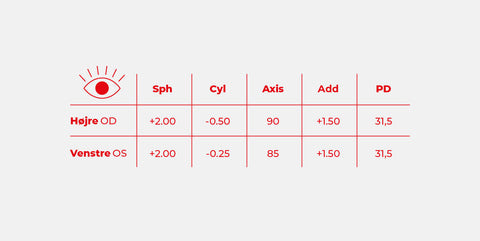
The eyeglass prescription above shows that…
… the person is farsighted (hypermetropic): Both sphere values are positive (+2.00 and +2.00), meaning the person has difficulty seeing clearly up close without glasses.
… there is slight astigmatism: Indicated by the small negative cylinder values, which are corrected with an axis.
… add of +1.50: Suggests age-related near vision difficulties (presbyopia), so the person needs extra strength for reading, also called farsightedness (+).
… PD of 63 mm in total (31.5+31.5): Used for correct centering of the lenses.