


Are you farsighted? It can be difficult to tell if you are farsighted or nearsighted. Read on to find out if you are farsighted, what it means to be farsighted, why it occurs, and what treatment options and preventions are available…
What is farsightedness?
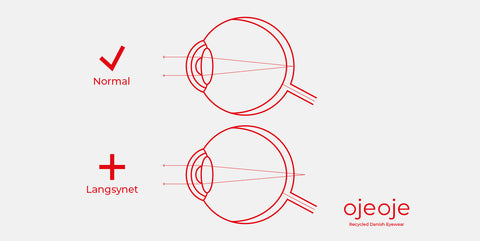
Farsightedness, also known as hyperopia or hypermetropia, is a very common eye condition where you see blurry up close and clearly at a distance. This means that if you are farsighted, you will have difficulty seeing clearly up close because text and small objects will be blurry. Farsightedness is caused by a refractive error where the eye's focus converges behind the retina (virtually) and not on the retina itself, as with a normal eye, leading to blurry vision for objects close to the eye. This typically happens because the eye is too short and refracts light too little. Image formation thus occurs behind the retina instead of directly on the retina, as the refractive power of the eye is too small relative to the eye's length. Farsightedness is a quite natural visual limitation, often seen when there are between 40 and 50 candles on the cake. However, we don't know how many people are farsighted, as some can compensate for it because they are only slightly farsighted. Children are born farsighted in their first years of life, and it is important to contact an ophthalmologist or optician, as earlier treatment can prevent permanent vision problems.
What does farsightedness mean?
In professional terms, farsightedness is called hyperopia or hypermetropia. Most people from the age of 40 will experience farsightedness, also known as presbyopia or "age-related vision". Presbyopia comes from ancient Greek, and 'presbys' means 'old man' and 'ops' means 'eye', which is also why it was formerly called old man's sight. Presbyopia occurs because the eye lens stiffens with age and loses the ability to increase its curvature, thus preventing the eye from shifting from seeing sharply at a distance to focusing on things that are close. Farsightedness is quite normal, and it is typically something we notice when we hit 40 years old, and this is where most people need a good pair of reading glasses. A full 80% of Danes over 40 wear reading glasses or glasses with prescription! – so you are the exception if you don't experience your eyes having more difficulty focusing on the world during your 40s.
What does it feel like to be farsighted?
The main challenge of being farsighted is difficulty seeing things and reading texts up close. This means that if you are farsighted, things close to you will appear blurrier, while things further away will appear sharp. For example, if you have to concentrate and squint to see things up close, or concentrate to read messages on your mobile, there is a high probability that you are farsighted. You may also have difficulty reading the menu at a restaurant. You may also notice that a sign further down the street is easier to read than signs close to you. When we are around 40-50 years old, most of us will have difficulty deciphering small print, and we will feel that our arms are too short or the lighting is too dim when a text with small print needs to be read!
Psst! The advantage of being farsighted is that you often have no problems seeing clearly at a distance. In short: if you are farsighted, you see best what is furthest away.
What are the symptoms of farsightedness?
The first symptoms of being farsighted are often blurry vision at close range, tired eyes, frontal headaches, dizziness, and tension in the neck and shoulders as the eye muscles have to work harder. Often, symptoms can disappear by using reading glasses of the correct plus strength, as they provide sharp vision. Always have your vision checked by an optician if you experience:
- You have to squint to focus.
- You experience blurry vision when trying to decipher text or an SMS.
- Your eyes become tired and sore around the eyes when reading a book or on a screen.
- You have difficulty seeing sharply when shifting your gaze between two objects at different distances.
- You experience frontal headaches or tension around the eyes when reading.
- You have difficulty reading letters up close – especially in the dark.
- You are over 40 – for some it happens sooner, for others later, but your forties are the decade when you have to face the fact that you will probably soon get an extra accessory in the form of reading glasses.
- You've started doing the classic move of holding your phone further away to decipher small print – and it can feel like your arms are too short.
- … and what about dim lighting? Forget it. You might as well close your eyes, because it's impossible to see what it says anyway.
Why do you become farsighted – and is it hereditary?
Farsightedness can be hereditary, but often we all begin to notice it when we hit 40+, when the elasticity of the eye decreases. This is a natural consequence of aging and the condition will worsen until we reach about 60 years of age, when vision will stabilize.
Is farsightedness plus or minus?
Farsightedness is plus. In short, if you have difficulty seeing things that are close up, you will typically be farsighted and need plus glasses (+), also called reading glasses or glasses with a plus prescription. If you are nearsighted, you will have difficulty seeing things at a distance, and you will typically be nearsighted and need minus glasses (-). This means that if you are farsighted, you see best things that are far away – and if you are nearsighted, you see best things that are closest. When you are farsighted, the image is formed behind the retina, and if you are nearsighted, the image is formed in front of the retina. Both mean that you cannot see clearly and need glasses or contact lenses of the correct prescription.
Can farsightedness be trained away?
No – unfortunately, you cannot train away age-related farsightedness, but it is possible to postpone it by a few years by being mindful of your eyes. You can maintain your vision by giving your eyes breaks from screens and books, avoiding glare, and ensuring good lighting. It is also important to vary your focus between things that are close and far away, as this keeps your vision in shape.
What strength is farsightedness?
There are many degrees of farsightedness, ranging from mild to severe, and if you need +0.5 in your spectacle lenses, you have very little difficulty, whereas if you have a spectacle strength between +2.0 and +3.0, you would not be able to function without a pair of reading glasses and would be severely farsighted.
If you are unsure which strength to choose for your new OjeOje reading glasses, you can use our age-based strength guide as a rule of thumb:
35-40 years: +0.5
40-45 years: +1.0
45-50 years: +1.5
50-55 years: +2.0
55-60 years: +2.5
60-65 years: +3.0
– if you are wavering between two strengths, we always recommend choosing the lowest, as it can feel uncomfortable to increase strength too quickly. We also recommend that you have your vision tested annually or biennially by an optician.
Can farsightedness disappear on its own?
Farsightedness cannot disappear, but in some cases, farsightedness can be operated on with a laser surgical procedure on the eye's cornea, where the eye's refraction is changed. However, not everyone is suitable for eye surgery, but a thorough eye examination can provide an answer. The most commonly used surgical method is laser treatment, which can correct presbyopia.
What can help against farsightedness?
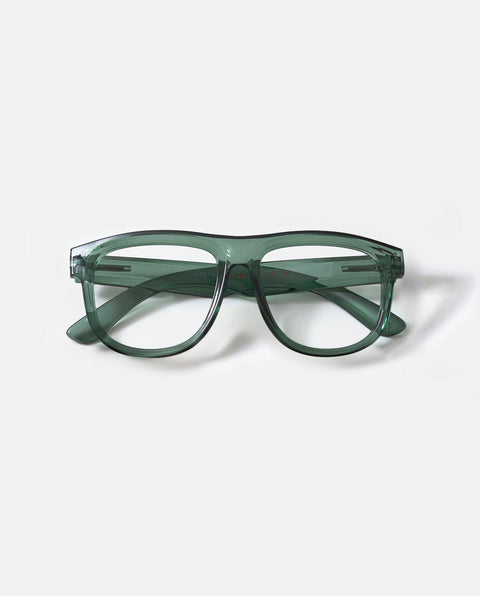
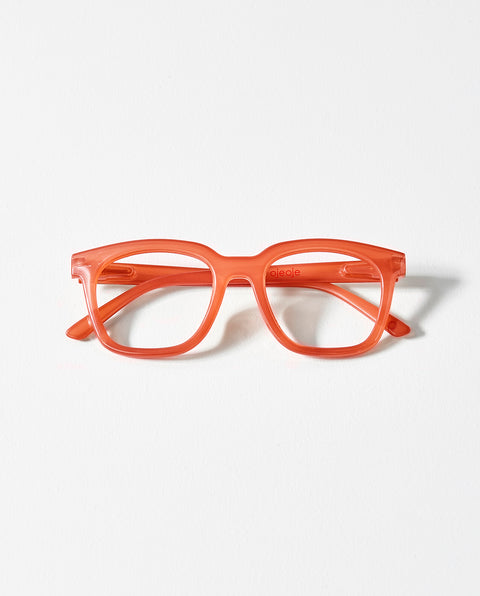
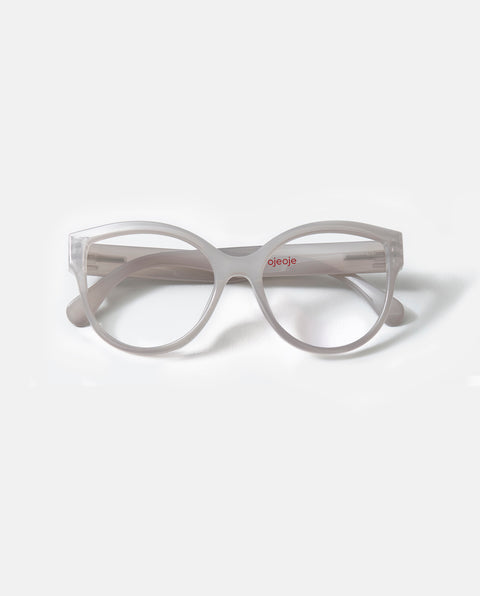
Reading glasses with the correct plus power will be the easiest way to correct farsightedness. You can also use convex lenses, which are contact lenses with plus power and a convex shape. The shape curves outward, being thickest in the middle and thinnest at the edge, and is for nearsighted individuals. We always recommend that you have your vision tested annually or every other year by an optician. Regular eye exams ensure that your glasses or contact lenses have the correct prescription.
Psst... if you are farsighted and love to read books outdoors, keep an eye on our cool recycled sunglasses with prescription. With a pair of OjeOje sunglasses with or without prescription, offering 100% UV protection, you can both protect your eyes and look good!
Are you farsighted?
If you are 40+, there is a high probability that you are farsighted. A full 80% of Danes over 40 wear reading glasses or glasses with prescription! – so you are the exception if you don't experience your eyes having more difficulty focusing on things up close during your 40s. Whether you are farsighted is determined by an eye exam at an ophthalmologist or optician. Visual acuity is measured for both of your eyes, both individually (monocularly) and together (binocularly). When your eyes are tested individually, it is important that the other eye is closed or covered. You will be placed in front of a chart – you probably remember the doctor's chart with symbols and figures from your childhood. But the vision chart used for adults has letters or numbers arranged in rows, where the top ones are the largest and the bottom ones are the smallest. The distance from your eyes to the chart will usually be six meters. You will be asked to read the letters on the chart as the optician points from the top line downwards. The more letters you can read from the bottom line at a fixed distance, the better your visual acuity. In addition to testing how sharply your eyes see at different distances, the ophthalmologist will also test how your eyes work together, how flexible and mobile your eyes are, and your eyes' reaction to light.
If you are farsighted…
… your eye is too short relative to its optical power – which means the image of the outside world is formed behind the retina.
… you have sharp vision at a distance, but blurry vision for things up close.
… it can often be corrected with a pair of reading glasses or contact lenses with a plus prescription.
How often should your vision be checked?
Initially, you can check your own vision to get a sense of whether it's functioning optimally. You can test it by first covering one eye with one hand, then the other. Do you see well? And with both eyes? Or is there a difference? If your vision is sharp, there's no reason to invest in a pair of plus glasses – unless you love glasses and want a pair of glasses without prescription. But keep a close eye on whether your vision changes – and if it does, make an appointment with an ophthalmologist or optician. The same applies if you suddenly experience other changes in vision, such as:
- You have to hold your mobile or book far away from your face to see clearly, which is often due to farsightedness. If you are farsighted, the problem can often be solved with a pair of reading glasses.
- You squint when watching TV or driving, which is often due to nearsightedness.
In short: have your vision checked every year or every other year by an optician or ophthalmologist, and generally keep an eye on your vision.
How do you avoid worsening vision?
Whether you are farsighted, nearsighted, or have astigmatism, it is important to have your vision corrected. If not, you will likely experience fatigue, headaches, or tension around your eyes due to the strain on your eyes, and your vision will deteriorate more quickly.
Overview of the 4 types of vision:
Normal vision: When an eye has normal vision, it means that the curvature and length of the eye are normal.
Farsighted (hyperopia or hypermetropia): With farsightedness, the eye is too short, and you have difficulty seeing things up close.
Nearsighted (myopia): With nearsightedness, the eye is too long, and you have difficulty seeing things at a distance.
Astigmatism: Normally, the eye should be perfectly round, but is more elongated, like an American football.