




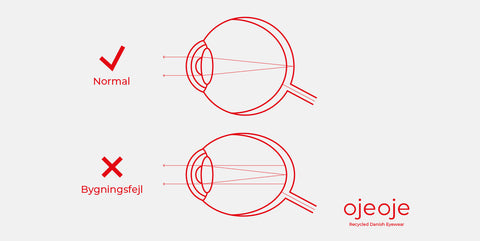
When we spot an eye defect – also known as astigmatism – it is often an asymmetrical curvature in the eye's cornea or lens, which causes vision disturbances. Read on to find out who is affected by astigmatism, why it occurs, what vision symptoms are associated with it, and what treatment options are available…
What is astigmatism?
Astigmatism, also called astigmatism, is one of the most common vision problems, and is a very common refractive error where the eye's cornea (the clear surface at the front of the eye) or lens has an irregular shape. Instead of being round like a football, the cornea or lens is shaped more like an American football. The irregular shape prevents light from focusing correctly on the retina – the light is focused at points behind and/or in front of, and not on, the retina itself, which causes vision disturbances such as blurred vision or distorted vision of objects both at a distance and up close.
However, astigmatism can also develop alongside other vision disturbances such as myopia and hyperopia.
What is the cornea vs. the lens?
The cornea is the outermost protective part of the eye – a thick, clear membrane shaped like a dome, measuring approximately 11 mm in diameter. The cornea is transparent, allowing light to pass into the eye. The function of the cornea, together with the lens, is to refract light to the retina, where the light is converted into impulses that are sent to the brain and converted into images that can be seen at various distances.
The eye's lens is an optical component located directly behind the cornea and iris, and is also clear and transparent like the cornea. The lens is suspended by many small, fine threads so that it can change shape. The function of the lens, together with the cornea, is to refract the light, which is then gathered on the retina, where the light is converted into impulses that are sent to the brain and converted into images that can be seen at various distances.
What can cause astigmatism?
Several factors – or a combination of them – can cause a refractive error:
- Irregular curvature of the eye's cornea
- Irregular curvature of the eye's lens
- The eye changes shape or size
- The eye is too short or too long
Who is affected by astigmatism?
The precise reason why some of us develop astigmatism is unknown – as there can be many different causes of astigmatism, but one cause is seen more often than others: heredity. It is believed that astigmatism is often congenital. Almost everyone is born with a small degree of astigmatism, and for most, it functions fine in everyday life without any challenges. The astigmatism is an asymmetrical curvature in the cornea or lens that is not serious.
Can you suddenly develop astigmatism?
Yes – astigmatism can suddenly arise as a result of eye injuries, eye surgeries, or due to the eye disease keratoconus, where the cornea is unevenly curved outwards in the middle – a kind of cone-shaped bulge. Bonus info: the name keratoconus is Greek and means cone-shaped.
What symptoms does astigmatism cause?
The symptoms of astigmatism can vary depending on the severity of the refractive error. Look out for the 5 most common symptoms of astigmatism:
Blurred or distorted vision: This is the most common symptom, affecting both near and distant vision.
Headaches: If the eyes have to work hard to focus, it can lead to tension and frequent headaches, especially after reading and screen time.
Eye strain: Overexertion of the eyes, where you have focused on the same task for a long time, can cause tired eyes
'Night blindness' (nyctalopia): Many people with astigmatism have difficulty seeing clearly in low light conditions, especially at night, and this can affect driving in the dark.
Squinting or double vision: In rare cases, astigmatism can cause squinting or double vision, especially if you have other refractive errors such as myopia or hyperopia
How is astigmatism diagnosed?
If you experience any of the above symptoms, it is important to have an eye test performed by an ophthalmologist or optician, who can determine if you have astigmatism through a thorough eye examination. You will be placed in front of a chart where you will look at the letters on the chart through a phoropter (device), which measures your eyes' vision using different lenses. The distance from your eyes to the chart will usually be six meters. You will be asked to read the letters on the chart as the optician points from the top line downwards. The more letters you can read from the bottom line at a fixed distance, the better your visual acuity. In addition to testing how sharply your eyes see at different distances, the ophthalmologist will also test how the eyes work together, how flexible and mobile your eyes are, and the eyes' reaction to light. The eye test will determine if you have astigmatism and establish if you are, for example, myopic or hyperopic.
What types of astigmatism are there?
In short: there are two main types of astigmatism:
1. Corneal astigmatism: This is the most common type of astigmatism and is caused by an oval-shaped curvature of the eye's cornea (surface). The eye functions best when the surface is round like a soccer ball and not an irregular shape like a rugby ball.
2. Lenticular astigmatism: Similar to corneal astigmatism – but where the lens is affected – and not the outermost part of the eye. Some people may have a correctly shaped cornea but still have lenticular astigmatism.
In addition to the two main types mentioned, there are also other types of astigmatism:
Myopic astigmatism: Here you will experience myopia. Myopia combined with astigmatism causes light to refract unevenly, thus focusing at different points in front of the retina.
Hyperopic astigmatism: Here you will experience hyperopia. Hyperopia combined with astigmatism causes light to refract unevenly, thus focusing at different points behind the retina.
Mixed astigmatism: Here you will experience both myopia and hyperopia, where vision is blurred at both short and long distances. This occurs when the curves are both myopic and hyperopic.
Astigmatism can also be divided into:
Regular astigmatism: The most common type of astigmatism and is often congenital, where the cornea is curved more in one direction than the other.
Irregular astigmatism: Is far less common and is caused by an uneven curvature of the cornea. Can arise as a result of eye injuries, eye surgeries or due to the eye disease keratoconus.
How is astigmatism treated?
The treatment of astigmatism depends on the degree of refractive error and symptoms. The most common treatment options are:
Glasses: Most people with astigmatism can achieve sharp vision with the help of glasses with lenses that have a cylindrical shape – a curved surface on one side and a flat surface on the other, which will correct the asymmetrical curvature in the cornea or lens.
Toric contact lenses: Specially developed lenses to correct astigmatism. These lenses have different curvatures in different directions, making it possible to correct both myopia and hyperopia in the same lens.
Night lenses – Ortho-K lenses: Rigid contact lenses used at night to reshape the cornea. When the lenses are removed in the morning, they can provide clear vision during the day without the use of glasses or contact lenses – however, the effect is temporary.
Laser treatment: Eye laser treatment is a surgical procedure that can permanently change the shape of the cornea and thus correct astigmatism. The treatment is typically recommended for people over 18 years of age, as vision must be stable before eye surgery.
Lens replacement: In some cases, surgical replacement of the lens may be a solution if other refractive correction surgeries cannot be performed. In this eye operation, the natural lens is removed and replaced with an artificial lens that can correct vision and last for the rest of one's life.
Psst! The advantage of a lens replacement is that you cannot develop cataracts, as it is the natural lens that is affected by cataracts.
What is the difference between astigmatism, myopia, and hyperopia?
Astigmatism, myopia, and hyperopia are collectively referred to as refractive errors of the eye, but they have different causes and affect vision in different ways:
Astigmatism: Occurs due to an uneven curvature of the cornea or lens, leading to blurred or distorted vision at both short and long distances. Normally, the eye should be perfectly round, but in astigmatism, it is more elongated, like, for example, an American football.
Myopia (nearsightedness): You have difficulty seeing things at a distance. This is often because the eye is too long, causing light to focus in front of the retina.
Hyperopia (farsightedness): You have difficulty seeing things up close. This is often because the eye is too short, causing light to focus behind the retina.
How does astigmatism affect everyday life?
Astigmatism can affect your daily activities such as reading, screen work, and driving – especially in the dark. It can also lead to fatigue, headaches, eye strain, vision disturbances and ocular migraines, which can affect your work performance and quality of life. If astigmatism is not corrected, it can be difficult to concentrate – especially on monotonous work that requires constant focus.
When should you seek help?
Although astigmatism is not dangerous, it is important to monitor whether you experience blurred vision, frequent headaches, or eye strain, as you should then contact your optician or ophthalmologist for a thorough eye test. Even small degrees of astigmatism can cause symptoms that can affect your daily life.
Can astigmatism worsen over time?
Yes, the degree of astigmatism can develop and in some cases worsen over time, as both the eye lens and cornea can change shape, but the degree can also decrease over time.