
As early as in their 40s, most people will experience changes in their eyes, which have been given the rather unattractive name 'old-age sight', 'age-related sight' – or simply presbyopia, as it is called in technical terms.
What is presbyopia (old-age sight)?
Presbyopia is a reduced ability to focus on close-up objects because the lens's ability to change curvature deteriorates with age. The change in the lens's curvature is a must for you to switch focus and see sharply at near and far distances – hence the most common vision defects: myopia and hyperopia. Read more in our article Are you farsighted (+) or nearsighted (-)?
What is curvature in the eye's lens?
To see objects or text up close, the eye's lens must be able to change to become more curved than when viewing sharply at a long distance. This regulation of the lens's shape is controlled by small muscles in the eye. When these small muscles contract, the lens thickens by 'bulging' out, allowing for sharp vision. This process is called 'accommodation' in technical terms, which literally means near focusing – where we switch focus from short to long distance and vice versa.
When will you experience presbyopia?
The lens's ability to change curvature already begins in the 40+ age group, where many will find it difficult to decipher small print. Have you noticed that small letters have started to blur? And that you can barely see what's on your phone or on the menu! And perhaps you've completely given up on reading ingredient lists on items in the supermarket? In most cases, it can be solved with a pair of reading glasses, which will allow you to decipher small print again. You could even jokingly call reading glasses the '40-year-old glasses' – glasses that can help you see clearly again despite your age. You can compare it to the lens of a camera – perhaps the image looks as it always does when you look through the lens. But when you want to see things up close or far away, it blurs a bit, and you can no longer focus sharply on the world around you. This is completely normal and harmless, and most people will need reading glasses when there are between 40 and 50 candles on the cake.
Is presbyopia dangerous?
No, it is completely harmless and a natural part of the aging process when you reach your 40s.
Can presbyopia disappear?
'Old-age sight', 'age-related sight' or presbyopia is not something you can ignore, as it won't go away – on the contrary, it will probably get worse. The distance in front of your eye where you can see sharply will, for most people, increase over time, so you will need to change glasses and strength regularly. But over the years, your vision will stabilize. Until then, we recommend that you have your eyes checked every year.
How do you treat age-related sight?
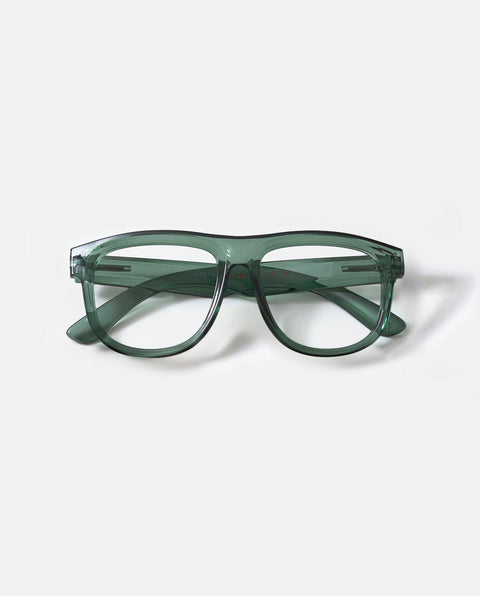
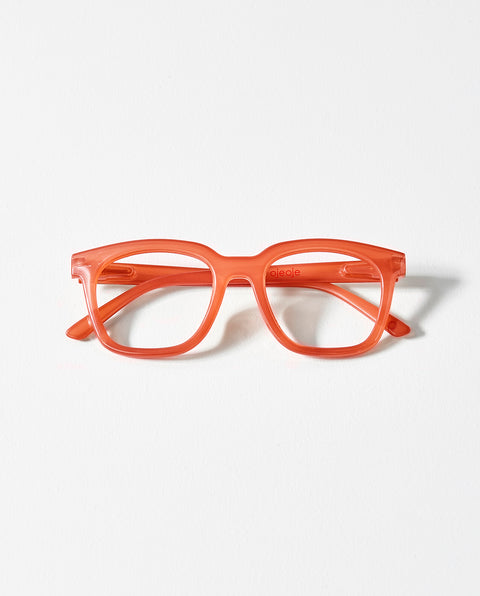
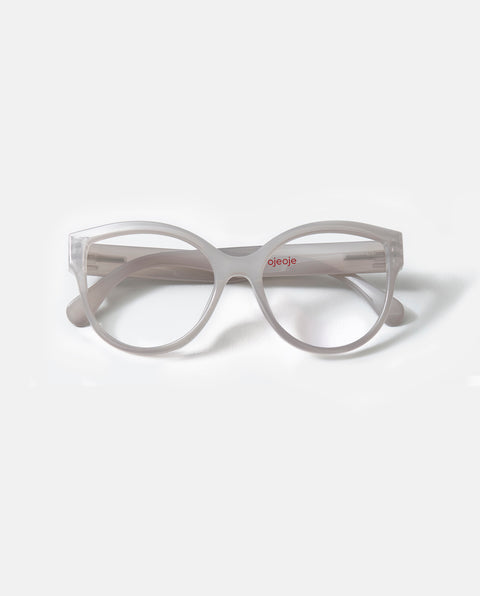
The easiest way to solve 'old-age sight', 'age-related sight' or presbyopia is to buy a good pair of reading glasses from OjeOje, where quality is top-notch – without the price following suit! See all our recycled reading glasses
Is it harmful to use 'ready-made' glasses or cheap glasses?
No, you cannot harm your vision or increase your age-related sight by using a pair of cheap reading glasses.
When do you need reading glasses?
A full 80% of Danes over 40 wear reading glasses or glasses with prescription! – so you are the exception if you do not experience difficulty focusing on the world during your 40s.
Watch out for the 7 most common signs that it's time for the 40-year-old glasses:
1. Your vision blurs when you try to decipher a text or SMS at a distance that you previously had no problems with.
2. Your eyes become tired and sore when you read a book or on a computer.
3. Your autofocus is out of whack, and your gaze is no longer sharp when you shift it between two things at different distances.
4. You've started doing the classic move of holding your phone, book, magazine, or similar far away to decipher the small print – and it can feel like your arms are too short.
5. You sometimes get headaches or tension around your eyes when you read.
6. You've turned 40 – for some it happens sooner, for others later, but your forties are the decade when you have to face the fact that you'll probably soon get an extra accessory in the form of reading glasses.
7. And what about dim lighting? Forget it. You might as well close your eyes, because it's impossible to see what's written anyway.
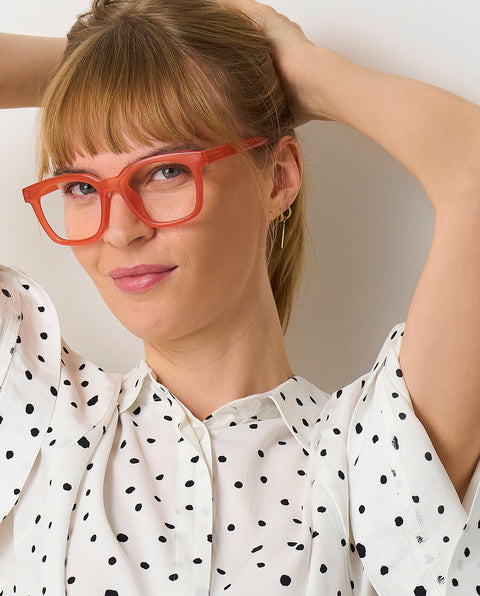
But there's no reason to be a pessimist – the right reading glasses can not only help you see the world clearly again, but also open your eyes to adding some extra color and edge to your style with a bold pair of glasses from OjeOje.
How often should you have your eyes checked?
If you've reached the age where you need reading glasses, we recommend having your eyes checked annually by an optician. If you're unsure whether you need glasses, you can initially check your own vision to get a sense of whether it's optimal. You can test this by first covering one eye with your hand, then the other. Do you see well? And with both eyes? Or is there a difference? If your vision is sharp, there's no need to invest in glasses – unless you love glasses and want a pair of glasses without prescription. But keep a close eye on whether your vision changes – and if it does, book an appointment with an optician. The same applies if you suddenly experience other changes in your vision, such as:
• You squint when watching TV or driving, which is often due to nearsightedness.
• You have to hold your phone or book far from your face to see clearly, which is often due to farsightedness. This is where a pair of reading glasses can often help.
In short: have your eyes checked annually by an optician, and generally keep an eye on your vision – and contact an optician if it changes.
Find your strength with our strength guide
If you are unsure about what strength you need for your reading glasses, you can determine your precise strength by getting an eye test at an optician. Most places offer them for free, and you are not obligated to buy glasses from them. You can also use our age-divided strength guide as a rule of thumb:
35-40 years: +0.5
40-45 years: +1.0
45-50 years: +1.5
50-55 years: +2.0
55-60 years: +2.5
60-65 years: +3.0
– if you are in doubt and wavering between two strengths, we always recommend choosing the lowest, as it can feel very uncomfortable to increase the strength too quickly.
Are you still unsure about your strength?
Don't hesitate to call us if you need personal assistance in choosing your strength, shape, and color.
Mon-Fri: 10 AM-3 PM
+45 60 58 00 96
contact@ojeoje.com
Get inspired for your new reading glasses
We have collected all our reading glasses so you can easily spot your new reading glasses. See all our recycled reading glasses
Always 3 pairs for DKK 600 including shipping
Once you reach the age for reading glasses, one pair is not enough. You need a pair on the bedside table, by the sofa, in the kitchen for reading recipes, and in your bag for on the go – because there's a risk of forgetting your glasses if you only have one pair, and three pairs last longer than one. Therefore, you can always buy 3 pairs of glasses for DKK 600 including shipping at OjeOje, and we recommend that you buy your 3 pairs at once to collectively save the environment from three separate shipments.
Visit our Showroom
Do you need help finding the right strength, shape, or color? Then stop by OjeOje's small Showroom, located in the designer's backyard in Kgs. Lyngby. In our Showroom, you can try on all our recycled reading glasses and sunglasses – and you can take them home the same day. We look forward to seeing you!
OjeOje Showroom
Chr. Winthers Vej 12A
2800 Kgs. Lyngby
+45 60 58 00 96
contact@ojeoje.com
Opening hours:
Tues: 3 PM-5 PM
Thurs: 3 PM-5 PM
(Closed during weeks 7, 29-31, 42 and 52, as well as public holidays)