


At OjeOje, we find that many people are unsure about what it means to be nearsighted – also known as myopia – as they often confuse nearsightedness with farsightedness. We understand this – because it can be hard to spot. Read on to find out what it means to be nearsighted, why it occurs, and what treatment and prevention options are available…
What is nearsightedness?
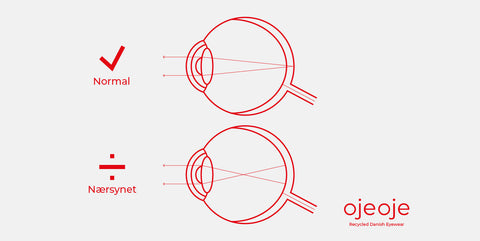
Nearsightedness is a vision defect where you see blurry at long distances and clearly at short distances. This means that if you are nearsighted, you will have difficulty seeing clearly at a distance because objects will be out of focus. Nearsightedness results from a refractive error in the eye, where the eye's focus converges in front of the retina instead of directly on the retina, as in a normal eye. This typically happens because the eye is too long, or the cornea is too curved and refracts light too much. Image formation therefore occurs in front of the retina instead of directly on it, as the refractive power of the eye is too great in relation to the eye's length. It is a quite natural vision limitation, which is the most common cause of vision changes, and is seen in one out of six Danes. Researchers estimate that 50% of the world's population will be nearsighted by 2050.
What does nearsightedness mean?
In technical terms, nearsightedness is called myopia, which is the Greek word for nearsightedness, and means reduced distance vision, often causing the nearsighted person to need to squint their eyes to see objects at long distances.
What does it feel like to be nearsighted?
The overarching symptom is reduced distance vision. This means that if you are nearsighted, things closer to you will appear clearer, while things further away will seem blurry. For example, if you have to concentrate to see people at a long distance, or concentrate to watch TV or movies at the cinema, there is a high probability that you are nearsighted. You may also have difficulty reading road signs when driving. You will find that you need to squint your eyes to see things far away, and this will typically cause tired eyes and headaches. The solution here would be to have your eyes checked by an optician and invest in a pair of minus-lenses with the correct strength.
Psst! The advantage of being nearsighted is that you have no trouble reading, deciphering small print, or seeing things up close. In short: if you are nearsighted, you see best what is closest.
What symptoms are there for nearsightedness?
Symptoms of being nearsighted can include blurred vision at a distance, eye irritation or tired eyes, headaches, dizziness, and tension pain in the neck and shoulders, and can often be resolved with a pair of glasses with the correct minus prescription. Always have your vision checked by an optician if you experience:
- You can see clearly at a short distance but not at a long distance.
- You squint your eyes to see objects at a distance.
- You have difficulty seeing when driving – especially in the dark.
- You have difficulty reading letters at a longer distance, e.g., road signs.
- You have difficulty recognizing people on the street.
- You need to sit close to the TV to read the subtitles.
- … and in a meeting room, you choose to sit close to the whiteboard.
Why do you become nearsighted – and is it hereditary?
Nearsightedness is quite harmless and a very common condition, affecting one out of six people here in Denmark. There is no simple explanation for why we develop nearsightedness or myopia, but there is a tendency for both heredity and lifestyle to have a great impact on our vision. It usually begins to be noticeable in childhood or adolescence and will worsen over a lifetime. But in most cases, the development of nearsightedness stagnates after the age of 25-30. Many people experience a worsening of their vision during their studies, as their eyes are subjected to constant focus with reading texts with very small letters. This can affect vision and develop myopia.
Is nearsightedness plus or minus?
Nearsightedness is minus. Briefly, it can be described as, if you squint your eyes to see things far away, you will typically be nearsighted and need minus glasses (-). If you are farsighted, you will often have difficulty seeing things up close – and you need plus glasses (+), also called reading glasses or glasses with plus strength and are for those who are farsighted. This means that if you are nearsighted, you see best what is closest – and if you are farsighted, you see best things that are far away. If you are nearsighted, the image is formed in front of the retina, and if you are farsighted, the image is formed behind the retina. Both make it so that you cannot see clearly and need glasses.
Can nearsightedness be trained away?
No – unfortunately not. There are many degrees of nearsightedness, ranging from mild to severe, and if you need -1.0 in your spectacle lenses, you only have a slight inconvenience, whereas if you have a spectacle prescription of -7.0, you will not be able to function without a pair of minus glasses, and will be severely nearsighted.
Can nearsightedness go away on its own?
Nearsightedness cannot disappear, but with the help of an eye operation, you can change the eye's refraction on the cornea, so much of the degree of nearsightedness becomes much less or disappears completely. The most commonly used surgical method is laser treatment, which can correct myopia. If you are severely nearsighted and have a minus power of at least 6.0 in both eyes, you can get a free eye operation in Denmark.
However, recent studies show that the development of myopia in children can be slowed down with eye drops or the use of contact lenses at night.
What can help against nearsightedness?
Glasses with the correct minus power will be the easiest way to correct nearsightedness. You can also use concave lenses, which are contact lenses that are curved inwards, and are for nearsighted people. We always recommend that you have your vision tested every year by an optician. Regular eye exams ensure that your glasses or contact lenses have the correct prescription.
How do you prevent nearsightedness?
Research has been conducted into how various activities can slow down the development of myopia, and which you can incorporate into your daily life with a few considerations. Discover 3 good tips that can prevent the development of nearsightedness:
-
Daylight and fresh air: Outdoor light has a significant impact on how myopia develops. Light releases the neurotransmitter dopamine, which reduces the axial length of your eye, thereby reducing the development of nearsightedness.
-
Less screen time: Your eyes are not designed to focus for long periods in front of your computer or mobile screen, and this has a negative impact on the development of nearsightedness. Try to take more breaks and spend a maximum of one hour in front of the screen, reduce the screen brightness, or set the screen to Night Shift. Keep your eyes moist by blinking.
- More breaks: Do you read a lot or do you have a monotonous job that requires constant focus at the same distance? Then remember to take breaks so your eyes can rest and you avoid tired eyes.
Are you nearsighted?
One in three adults and one in five children here at home are nearsighted, so perhaps you are also nearsighted if you have difficulty seeing things at a distance? Whether you are nearsighted is determined by an eye exam at an ophthalmologist or optician. Visual acuity is measured in both your eyes, both individually (monocularly) and together (binocularly). When your eyes are tested individually, it is important that the other eye is closed or covered. You will be placed in front of a chart – you probably remember the doctor's chart with symbols and figures from your childhood. But the eye chart used for adults has letters or numbers arranged in rows, where the top ones are the largest and the bottom ones are the smallest. The distance between your eyes and the chart will usually be six meters. You will be asked to read the letters on the chart as the optician points from the top line downwards. The more letters you can read from the bottom line at a fixed distance, the better your visual acuity. In addition to testing how sharply your eyes see at different distances, the ophthalmologist will also test how the eyes work together, how flexible and mobile your eyes are, and the eyes' reaction to light.
If you are nearsighted…
… your eye is too long in relation to its optical power.
… you have sharp vision for things close up, but blurry vision at a long distance.
… it can be corrected with a pair of minus glasses or contact lenses with minus power, or by surgery.
How often should your vision be checked?
Firstly, you can check your own vision and get a sense of whether it is functioning optimally. You can test it by holding one hand over one eye and then over the other. Do you see well? And with both eyes? Or is there a difference? If your vision is sharp, there's no need to invest in a pair of glasses – unless you love glasses and want a pair of non-prescription glasses. But keep a close eye on whether your vision changes – and if it does, book an appointment with an optician or ophthalmologist. The same applies if you suddenly experience other changes in your vision, such as:
- You squint your eyes when watching TV or driving, which is most often caused by nearsightedness.
- You have to hold your phone or book far away from your face to see clearly, which is most often caused by farsightedness. If you are farsighted, the problem can often be solved with a pair of reading glasses.
In short: have your vision checked annually by an optician, and generally keep an eye on your vision – and contact an ophthalmologist or optician if it changes.
How do you avoid worsening vision?
Whether you are nearsighted or farsighted, it is important to have your vision corrected. If not, you will likely experience fatigue, headaches, or tension around your eyes due to the strain on your eyes, and your vision will worsen more quickly.
Overview of the 4 types of vision:
Normal vision: When an eye has normal vision, it means that the curvature and length of the eye are normal.
Nearsighted (myopia): With nearsightedness, the eye is too long, and you have difficulty seeing things at a distance.
Farsighted (hyperopia or hypermetropia): With farsightedness, the eye is too short, and you have difficulty seeing things up close.
Astigmatism: Normally, the eye should be perfectly round, but it is more elongated, like an American football.
Frequently asked questions about nearsightedness
When should you wear glasses if you are nearsighted?
You should wear glasses when your distance vision affects your daily life. This applies, for example, when driving, at school, at work, or when watching TV and movies. If you start to strain your eyes or get headaches, it is a sign that your vision should be corrected.
What kind of glasses should you wear if you are nearsighted?
If you are nearsighted, you should use glasses with a minus prescription. These can be regular minus glasses or contact lenses with concave lenses, which correct the refractive error so that the image hits the retina correctly.
Is nearsightedness hereditary?
Yes, heredity plays a role, but lifestyle also has an impact. A lot of screen work and long periods of close-up focus can increase the risk. Nearsightedness often starts in childhood or adolescence and typically stabilizes after the age of 25–30.
Can nearsightedness be treated or prevented?
Nearsightedness cannot be trained away, but it can be corrected with minus glasses, contact lenses, or laser surgery. Outdoor daylight, fewer hours in front of screens, and more breaks can help slow down its development – especially in children.